
What is the Nile Delta?
Picture the Nile Delta as a vast triangle of thriving green in northern Egypt, where the mighty Nile fans out to meet the Mediterranean Sea. Spanning about 240 kilometers along the coast and 160 kilometers inland, this lush patchwork has formed over millennia from rich silt deposits, earning its reputation as some of the world's most productive farmland. Thanks to its nourishing soil and endless water supply, the Nile Delta has always been Egypt’s heart of farming, culture, and settlement. It fostered bustling cities, international trade, and flourishing civilization, and even today, its fields and communities remain alive with activity.History of the Nile River
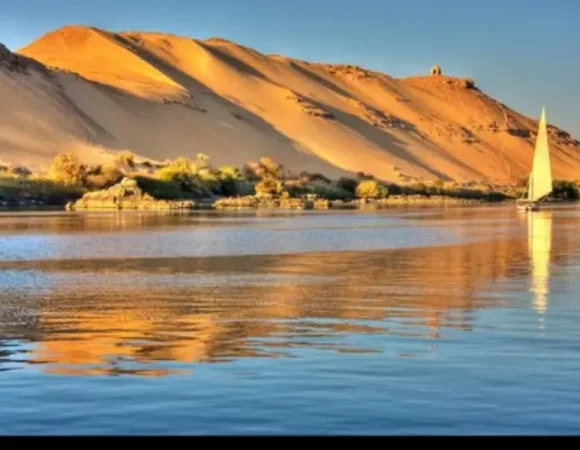
The Nile of Egypt
Ancient Egyptian civilization was built upon the Nile. Its yearly floods turned the dry deserts into fertile agricultural lands, enabling farming to thrive. The great cities and monuments of Egypt could never have been in existence without the life-giving waters of the Nile.The Nile and the Golden Age of Settlements
Communities have settled along the banks of the Nile as early as 5000 BCE. They taught them how to cultivate the fertile land, tame the animals, and settle in permanent villages. These were small settlements that eventually developed into the mighty kingdoms that became Ancient Egypt.Nile during the Old Kingdom (c. 26862181 BCE)
The Nile was a source of unity during the Old Kingdom. It connected lower and upper Egypt, which allowed economic growth and political stability. The river also facilitated the transportation of huge stone blocks to be used in constructing the pyramids, making it useful in monumental works.The Agricultural Expansion and Middle Kingdom (c. 20551650 BCE)
The Egyptians also invented highly sophisticated irrigation methods to manage the Nile waters in the Middle Kingdom. During the natural flood period, canals and basins were constructed to allow farming to continue when the natural flood did not occur. This agrarian development caused an increase in the population and the improvement of trade connections.Trade and Empire: New Kingdom (c. 15501070 BCE)
At the New Kingdom, the Nile had opened up international trade. Egyptian vessels travelled southwards into Nubia and also eastwards to the Red Sea, exporting gold, ivory, incense, and exotics. The river also assisted Egypt in its military strength by transporting the armies quickly.The Nile as a Holy Image
The Nile was termed a gift of the gods. There was the god of inundation, Hapi, who helped to assure the annual floods, which were revered by Egyptians. The river was associated with life, death, and rebirth, and it gave birth to myths and rituals that influenced Egyptian religion and culture over a millennium.The Nile in Greco-Roman Times
The Nile continued to serve as the lifeline of Egypt after Alexander the Great had been conquered and was under Roman rule. It provided grain that nourished the Roman Empire and still nourishes the Egyptian society, which demonstrates its significance at various periods of time.Where Does the Nile River Start?
The Nile has two main sources: the White Nile, which begins at Lake Victoria in East Africa, and the Blue Nile, which originates from Lake Tana in Ethiopia. These two rivers meet at Khartoum, Sudan, forming the Nile that flows into Egypt.Where is the Nile River Delta Location?
The Nile River Delta is in Lower Egypt, stretching from Cairo northwards to the Mediterranean. It lies between the two main distributaries of the river: the Rosetta branch on the west and the Damietta branch on the east. This luxuriant region has historically been the most populated part of Egypt.The Geography of the Nile River
The Nile is flowing northwards over deserts, highlands, and plains. In Egypt, it divides into two great distributaries which form the delta. Not only did its geography define the physical landscape of Egypt, but the geography also determined the political and cultural boundaries that formed Egypt, including the unification of Upper and Lower Egypt.Nile River Map

How Long is the Nile River?
The Nile River is quite long (around 6,650 kilometers long or 4,130 miles long). It passes through 11 other nations to the Mediterranean Sea, which is located in the North of Egypt.The Blue and the White Nile
The Nile is so extraordinarily long because of the two great tributaries of it:- The so-called longer branch, the White Nile, originates in the East African region, on Lake Victoria, and flows through such countries as Uganda and South Sudan.
- The smaller but more formidable one, the Blue Nile, washes out of Lake Tana in Ethiopia and supplies the bulk of the fertile silt and seasonal floodwaters of the river.
- The two tributaries converge at Khartoum, Sudan, where they merge to create the mighty Nile that flows north into Egypt.
The Long March to Civilization
The Nile did not merely have a great length as a geographical characteristic, but it was a vein that bound together different cultures and geographies. Its waters were a source of food and transport as well as spirituality in the highlands of Africa to the deserts of Egypt. Its size alone rendered it the lifeline of civilizations, with ancient Egypt being the most eminent.Significance of its Length Culturally
The Nile, spanning over numerous lands, was a factor that symbolized unity to the ancient Egyptians. They thought that this unending flow of the river was an indicator of divine order, which showed stability and eternal life, and it was deeply rooted in their culture and religion.Nile River Countries
The Nile flows through the following countries:- Burundi
- Rwanda
- Uganda
- Tanzania
- Kenya
- South Sudan
- Sudan
- Democratic Republic of Congo
- Eritrea (indirectly through tributaries)
- Ethiopia
- Egypt
Divine Religious Facts of the Nile River for the Egyptians
- Nile, a Godsend
- Hapi- God of the Nile- Spirit of the Flood
- The Nile in Ancient Egyptian Legend
- Osiris, god of rebirth and the afterlife, was associated with the Nile. The flood of the river was believed to represent the life-giving powers of Osiris by the Egyptians.
- The eastern side of the Nile was the symbol of life and the emerging sun, where humans created villages and farms.
- The west bank was the representation of death and the setting sun, in which Egyptians constructed tombs and temples to be used in the afterlife.
- Nile Festivals and Nile Rituals
- The River: the Road to Immortality