
Nobody built the pyramids. Not in the way we picture it.
No single architect looked up one morning and said "right, let's stack two million limestone blocks." What actually happened was slower, stranger, and far more interesting. A civilization had to feed itself first. Surplus by surplus, season by season, an agricultural system had to exist and function and generate enough to support people who weren't farming — scribes, priests, soldiers, builders, kings.
That system was the Egyptian farmer. And the daily life of farmers in ancient Egypt, the actual texture of it, is something most history books skip past in a paragraph.
They shouldn't.
The River that made civilization possible
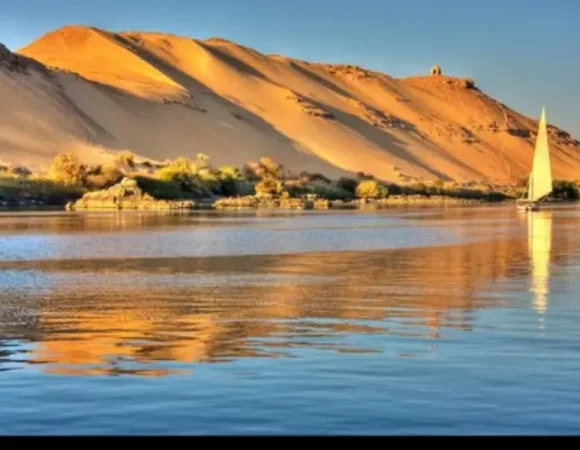
Egypt, from its very foundations, is a country surrounded by desert. This may be an apparent statement, but it needs to be reiterated. The Sahara Desert surrounds Egypt on all sides. If it were not for the Nile River, none of this – the pyramids, the temples, and thousands of years of continuous civilization – would exist. It is just impossible.
Every year, the Nile River would overflow. This was not by chance or coincidence; it happened in a sequence that the ancient Egyptians could predict. It overflowed, covered the farmland in water, and then receded, leaving behind a layer of rich black soil. Rich in nutrients, fertile, and did not need any additional nutrients added to it. The ancient Egyptians called the fertile land as "Kemet" which translates to "Black Land". The desert region beyond it was called "Deshret" or "Red Land". The line between them was stark and literal — you could stand with one foot in farmable soil and one foot in sand that would grow nothing.
That silt was, functionally, the entire economy. It renewed itself every year without anyone doing anything. No plowing it in, no fertilizers, no soil amendments. The river did the work. The farmer's job was to manage what came after.
What their days actually looked like? Daily Life of Farmers in Ancient Egypt
Here's what gets lost when we describe the daily life of farmers in ancient Egypt as "hard work and simple food": it wasn't generic hardship. It was a very specific kind of life, shaped by a very specific river, in a very specific climate.
Up before dawn. Every day. Not because they were especially disciplined but because the alternative was working in midday Egyptian heat, which in summer regularly exceeds 40°C. You got your work done in the morning or you suffered for it.
Breakfast was bread — made from emmer wheat, dense and grainy — and beer. Not the kind of beer anyone drinks now. Think of it more like liquid bread, thick and mildly fermented, closer to a protein shake than a pint. It was nutritional, not recreational. Children drank it. Everyone drank it. The Nile water wasn't safe without treatment, and beer was.
Then out to the fields. Depending on the season: irrigation of ditches, plowing the soft soil made wet by floods, planting seeds, taking care of growing crops, or harvesting. Lunch break, under the shelter of the banks of a canal or of a sycamore fig tree if one was lucky enough. Lunchtime, and then back to work until dark. Home. Supper, which was pretty much like breakfast, except for the addition of Nile fish, whether fresh or dried, or even onions and garlic.
Then sleep. Then again.
There's a papyrus from around 1200 BCE that describes a farmer's life and it doesn't romanticize it at all. The scribe who wrote it was trying to persuade a student that being a scribe was better. He describes the farmer sunburned and exhausted, eaten by insects near the canals, burdened by taxes, barely resting. He wasn't wrong. But he also wasn't telling the whole story.
Also read about: what airport is in Egypt
The seasons governed everything
Ancient Egyptians divided their year into three seasons, and those seasons weren't just agricultural categories — they structured all of life.
Akhet: The Flood Season
Akhet ran roughly June to September, and it was the flood season. The fields went underwater. You couldn't plant, couldn't harvest, couldn't do much of anything on the land itself. This is when large numbers of farmers were pulled into state labor — building projects, monument construction, the kind of organized work that required thousands of hands at once. This is probably where much of the pyramid labor actually came from: not enslaved people, but farmers who had nothing else to do while the Nile had their fields.
And while they were gone, the river was doing something useful. The floodwaters deposited that silt, quietly and without ceremony, getting the soil ready for what came next.
Peret: The Growing Season
Peret, October to February, was growing season. The water receded, the soil was soft and black and fertile, and farmers moved fast to get seeds in the ground. Emmer wheat. Barley. Flax. Vegetables. The cooler air made it actually pleasant to work outside — this was the most humane time of year for field labor, and the Nile Valley during Peret looked like something out of a painting. Vivid green against the pale desert on both sides.
Shemu: The Harvest Season
Shemu, March to May, was harvest. The heat was back, the work was intense, and the whole family was in the fields. Sickles cutting grain stalks, bundles being carried to threshing floors, oxen walking in circles over the grain to separate it from the chaff. And then the scribes arrived. Government scribes assessed every harvest and collected tax — roughly 20% of what you'd grown. No exceptions. Missing a payment meant punishment, debt, sometimes forced labor.
A bad flood year could make that 20% impossible to pay. Which is when things got very hard very quickly.
The tools were simple and they worked
The shaduf is worth describing because most people don't know it and it's genuinely clever.
The shaduf
Imagine a long pole balanced on a crossbeam, like a seesaw. On one end, a heavy counterweight — packed mud, usually. On the other end, a rope with a bucket. You pull the bucket end down into the canal, fill it with water, then let the counterweight do the lifting. The water swings up and you tip it into your irrigation channel. One person, no machinery, moving water from a canal to a field several feet above it.
That's a shaduf. It was invented in ancient Egypt and versions of it are still used in parts of the Nile Valley today. Four thousand years. Same basic mechanism.
Nilometers
They also built Nilometers — stone markers in the river used to gauge how high the flood was rising. This mattered enormously. A low flood meant thin silt deposits and a weak growing season. An extremely high flood could overwhelm the earthen walls farmers built around their fields, destroy stored grain, kill animals, wash out homes. The ideal flood was specific, and reading the Nilometer gave farmers weeks of warning about what was coming.
Other tools
Their other tools: a wooden plow pulled by oxen (the silt was soft enough after flooding that this worked without iron), hoes for weeding and breaking clods, bronze sickles for harvesting, winnowing fans for tossing threshed grain into the breeze and letting the chaff blow away. Nothing complicated. Nothing that required metallurgy beyond basic bronze work.
It was enough. It fed a population that, at its height, reached several million people, and generated surpluses large enough to build the most recognizable structures on Earth.
Also read about: Colossi of Memnon location
What they believed about all of it
Religion didn't sit alongside farming in ancient Egypt. It was farming, at least conceptually.
Osiris
The god Osiris — one of the most important in the entire Egyptian pantheon — was the god of both the afterlife and vegetation. His mythology followed a cycle: he was killed, his body was scattered, he was reassembled and resurrected. That story mapped directly onto what crops did. The grain died, went into the earth, and came back. The same cycle, every year. Osiris was not merely a metaphor for farming; rather, farming was a sort of tangible evidence that his resurrection was true and constant.
Hapi
The god Hapi was the one who represented the flood of the Nile, portrayed as a person with a blue/green body and holding water plants. The farmers offered Hapi sacrifices prior to the flood to get a flood which was abundant yet non-destructive. The cobra goddess Renenutet controlled the harvest. Min over fertility and planting. The agricultural calendar and the religious calendar were essentially the same document.
Farmers made regular offerings at local shrines. Not grand temple rituals — small, personal ones. A portion of bread, some grain, a prayer before sowing. After a good harvest, more substantial thanks. Religion gave meaning to the outcome of all that labor and offered a framework for dealing with bad years. When the flood came too low, or locusts arrived, or disease spread through a village, there was somewhere to direct that anxiety. It didn't solve anything. But it helped people keep going.
Also read about: what is under the Great Pyramids
Crops, Foods, and Animals in Ancient Egypt
Ancient Egyptian agriculture was more diverse than one would think. While grains were the main crops grown in Egypt, other crops and animals were raised to supply personal use as well as the state.
Main Crops Raised by Ancient Egyptian Farmers
Emmer wheat – the main cereal used for making bread which was eaten by all Egyptians
Barley – the cereal used mostly for making beer, the most popular drink in ancient Egypt
Flax – used to produce fibers for linen clothes as well as for oil from the seeds
Vegetables – onions, garlic, leeks, lettuce, cucumbers, and radishes
Legumes – lentils, chickpeas, and fava beans for protein consumption
Fruits – dates, figs, grapes, and pomegranates in the gardens and orchards
The Diet of Ancient Egyptian Farmers
Animals Used in Farming
Oxen — the most important draft animal, used to pull plows and thresh grain
Donkeys — used to carry loads and transport grain between fields and storage
Pigs — kept for meat and also used to trample seeds into the soil after planting
Geese and ducks — raised for eggs and meat
Goats and sheep — kept for milk, wool, and meat
Cattle — valued for labor, milk, and social status; wealthy farmers measured prosperity in cattle
The things that went wrong
Life as an Egyptian farmer was not stable or predictable, no matter how reliable the Nile was on average.
1. Too little flooding: thin silt, poor soil, weak crops, a season where you're producing less than you owe in tax.
2. Too much flooding: your earthen walls fail, your home fills with water, your grain stores are destroyed, you're starting over with nothing.
3. Locust swarms were catastrophic. One huge swarm was capable of stripping an entire field clean within hours – fields that took months to cultivate and would serve as your sole source of sustenance throughout the year. The water-borne diseases were rampant among people living around the canal area. Eye infections were especially common from dust and insects and are documented constantly in ancient medical texts.
4. And then the tax. Always the tax. Scribes didn't care about your circumstances. The assessment was based on flood levels and what should theoretically be grown, not what you actually grew. A farmer in a bad year was still expected to pay what a normal year would produce. Shortfalls meant debt or conscription into labor.
They kept going anyway. Generation after generation, family after family, this was the life. You planted because there was no other choice. And because the Nile always came back.
What this all actually built
Here is the thing about the daily life of farmers in ancient Egypt that tends to get lost: these people didn't just survive. They produced surpluses that funded one of the most sophisticated civilizations in human history.
The grain stored in Egypt's granaries was the state's budget. It fed the army. It paid the builders who worked on the pyramids. It sustained the priests, the scribes, the administrators, the architects, and the thousands of skilled craftsmen who created the art and objects that filled the tombs. Without continuous agricultural surplus, none of that support structure exists.
When historians ask how the pyramids were built, the real answer starts with a farmer waking up before dawn in the Nile Valley and going to irrigate his fields. That's the beginning of the chain. Everything else — the engineering, the organization, the quarrying, the hauling — all of it assumes that people are fed, and feeding a large workforce for decades requires a functioning agricultural economy.
Farmers also developed techniques that spread beyond Egypt. Basin irrigation, canal management, the shaduf — these weren't just local solutions. They traveled across the ancient Mediterranean and influenced agricultural practices in other civilizations for centuries.
The people who actually built this
History gives pharaohs the credit. That's understandable — pharaohs left more records. They built things with their names on them. But the daily life of farmers in ancient Egypt is, in a very direct sense, the story of how that civilization existed at all.
No surplus grain means no pyramid workforce. No workforce means no pyramids. No pyramids means a different civilization entirely — one that history probably doesn't still talk about three thousand years later.
The farmer woke up. Did the work. Paid the tax. Buried the dead. Planted again the next year. Did that across a hundred generations, in a strip of fertile land in the middle of a desert, next to a river they depended on completely and understood deeply.
That's not a footnote to ancient Egypt. That's ancient Egypt.