What Is Alexandria?
Alexandria is one of the most historical cities throughout the world and a city in Egypt. It was founded in 331 BCE by Alexander the Great to be an ancient hub of culture, trade, and learning. Situated along the Mediterranean Sea, Alexandria became bustling with scholars, traders, and adventurers. Features of Alexandria: History: Alexandria was the capital of Egypt for the duration of the Ptolemaic dynasty. It played a chief role in connecting the Mediterranean world to Africa, Asia, and above. The Great Library: The great library of Alexandria was the most famous library of the ancient world as it was conceived as a repository of all human knowledge. Scholars were there to study texts in all languages of the world, cultures, and disciplines. The Lighthouse of Alexandria: Also known as the Pharos of Alexandria, it was one of the Seven Wonders of the Ancient World. This lighthouse was built on what is now the island of Pharos and led to sailors through it to the bustling busy port of Alexandria. Cultural: It had a square cultural melting pot whereby the Greeks and Egyptians, as well as Roman and Byzantine cultures, interwoven. It was a leading city for early Christian theology and philosophy. Modern Alexandria: Today, Alexandria ranks as the second-largest city in Egypt and as a major center of the economy and culture. This city attracts visitors who enjoy its historic sites, Mediterranean coast, and lively atmosphere.Where Is Alexandria In Egypt
Alexandria is bounded by the Mediterranean Sea on the northern side of Egypt and is about 220 kilometers (137 miles) northwest of Cairo-the capital of Egypt. This city is located in the Nile Delta region, which serves as an important economic hub as well as a coastal area in Egypt. Key Geographical Features:- Mediterranean coastline: Alexandria stretches along the Mediterranean Sea, making it a strategic point in terms of trade and naval engagements.
- The eastern and western harbors: these natural harbors made Alexandria an important commercial city in antiquity.
- Proximity to the Nile Delta: The closeness to the rich fertility of the delta has always favored agricultural activities and commerce.
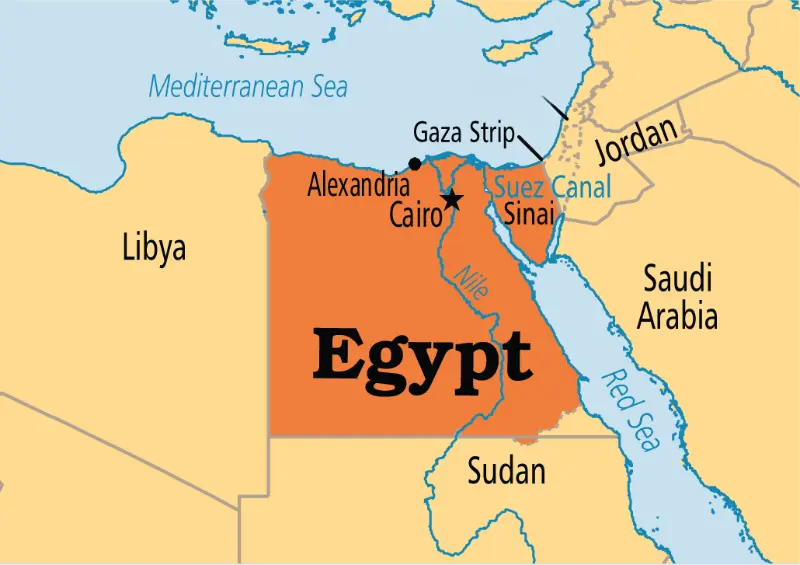
Where Is Alexandria In Egypt On A Map
Thus, Alexandria is found in the north of Egypt on the Mediterranean Sea, about 183 kilometers (114 miles) northwest of Cairo. The place is situated toward the western end of the delta in the Nile River, making it a significant port and center for culture. The following is the location of Alexandria on the map:- Latitude: 31°12'20.7108" N
- Longitude: 29°55'28.2936" E
 Read about: Egyptian Gods Names and Powers: Ancient Myths Explained
Where Is Alexandria In Egypt On The World Map
Alexandria is a city in northern North Africa. More accurately, it is within the northern part of Egypt and lies along the Mediterranean Sea coast. It is also located in the northeastern portion of the continent and adjacent to the Middle East. Geographical Coordinates: Latitude: 31°12′N Longitude: 29°55′E Information Location: This is the edge of the Nile Delta in the west that makes it a very important port city. It displays a distance of about 220 kilometers, 137 miles northwest from Cairo, the capital city of Egypt. Nearby Landmarks on World Map:- North: the Mediterranean Sea linking it to Southern Europe.
- West: Libya.
- East: The Sinai Peninsula and the Middle East.
- South: the wider African continent.
The History Of Alexandria Egypt
The Story of Alexandria of Egypt Alexandria, founded in 331 BCE by Alexander the Great, is one among the most historically important cities in the world. The history of Alexandria is a mixture of former glory, cultural fusion, and seafaring importance. The outline of its histories is as follows: Foundation and Early History (331 BCE – 30 BCE): Foundation by Alexander the Great:- According to the designs of Alexander it was to serve both purposes for mostly commercial use in his intended empire.
- Archi, a Grecian architect, designed the entirety, and with its grid design, it was even considered one of the most advanced cities of those times.
- Once Alexander died, the capital of his empire became the Ptolemaic Kingdom ruled by his general Ptolemy I and the almost secular family he founded.
- This new library and the Mouseion site were meant to be the future Alexandria's library and houses for scholars.
- Then the next marvel of engineering was constructed on the island of Pharos called the Pharos Lighthouse and became one of the Seven Wonders of the Ancient World.
- After the defeat of Cleopatra VII and Mark Antony by Octavian (later Emperor Augustus) in 30 BCE, Alexandria became a part of the Roman Empire.
- The city continued to be a main hub for trade and learning, albeit with a gradually lessening prominence.
- During this period, the city was emerging as one of the early centers of Christian thought.
- Saint Mark is generally believed to have established the Coptic Orthodox Church in Alexandria.
- The next fictional accounts of this period consist of rising tensions among pagan, Jewish, and Christian communities.
- Captured by Amr ibn al-As, the city was taken by the Muslim Arabs in 641 CE.
- The city now slowly declined, as slowly Cairo replaced it as the political and economic center of Egypt.
- Alexandria remained a trade port, but it was losing importance culturally and politically under the Islamic Caliphates.
- In the time of Muhammad Ali Pasha, Alexandria was rejuvenated into an apparent port and a gateway for trades to Europe.
- New infrastructure development included an entirely new port and canals.
- Alexandria became a cosmopolitan city with diverse communities of Egyptians, Greeks, Italians, and Armenians.
- During the Second World War, it played a significant strategic role because it was very close to all battlefronts such as El Alamein.
- Alexandria has developed into a modern city while preserving its historic landmarks.
- Currently, it is the second largest city in Egypt and still remains an important hub of culture and economy.
- Library of Alexandria: The ancient library, now destroyed, has been incorporated into the modern Bibliotheca Alexandrina as an inspiration and center for learning and culture.
- Architectural Heritage: The Catacombs of Kom El Shoqafa, along with the Roman Amphitheater and remains of Pharos Lighthouse, are a fraction of historic sites that remain much prized.
- Cultural Diversity: Alexandria's past tells of a mix of Greek, Roman, Egyptian, and Islamic history.
People And Culture Of Alexandria
Residents of Alexandria Alexandria's Demographics:- With over 5 million denizens, Alexandria stands second after Cairo in terms of population in Egypt.
- Most Alexandrians are Arabic-speaking Egyptians, but the city also adds other ethnic and cultural communities.
- For metaphor, Archeological Alexandria contains Greeks, Romans, Jews, and much later Armenians, Italians, and Syrians.
- This was the case that made Alexandria-and above all, during its heyday, a real melting pot.
- This time, mainly Muslims followed by substantial indicators of Coptic Christians populate more. So, as described, soft, as kind, some would say, and, above all, proud of its irremediably rich past.
- This is exhibited in ancient monuments, museums, and art - this is the heritage of the city closely related to its Greco-Roman past.
- The Islamic traditions brought after the Arab conquest also make Alexandria's architecture, language, and daily life more influences than ever.
- Authors, poets and writers have been under the spell of Alexandria for decades. Great Cavafy would soak up its atmosphere and its history.
- Also, this city involves art galleries, cultural festivals, and literary events, thus preserving its spirit as the center of creativity.
- Because Alexandria is very close to the sea, most of its food is seafood dishes, such as:
- Sayadiyah (dish made of fish and rice).
- Feseekh (a fermented fish usually eaten on holidays).
- Fresh bread and local pastries. Local ahwas, or coffee houses, are the hangouts for the city.
Places To See In Alexandria
Alexandria holds some of the really beautiful historical sites, cultural centers, and coastal attractions. Let us have a look at the selected sites that you need to visit while in Alexandria:- Historical Landmarks:
- It was built in 1477 CE by Sultan Qaitbay, precisely on the site of the ancient Pharos Lighthouse, one of the Seven Wonders of the Ancient World.
- It provides excellent views of the Mediterranean Sea and of the city.
- A modern version of the great Library of Alexandria.
- Houses a vast library, museums, art galleries, and the planetarium.
- This is the ancient sepulchral necropolis with a blend of Egyptian, Greek, and Roman architectural styles.
- It includes tombs, a banquet hall, and sculptures.
- One of the largest monolithic columns ever built - a triumphal column of Rome in honor of Emperor Diocletian.
- It was built in honor of Emperor Diocletian.
- Cultural and Religious Sites
- Alexandria National Museum:
- The national museum houses collections about the Greco-Roman, Coptic, and Islamic periods of Alexandria. It is situated in a restored palace built in Italian style.
- A mosque, which has a very artistic design and construction, is dedicated to the thirteenth-century Sufi saint.
- Along the Mediterranean, this is a beautiful waterfront promenade.
- Best enjoyed walking, eating, and looking out at the sea.
- The dazzling palace is surrounded by exquisitely manicured gardens.
- It has some beaches and picnic areas on the Mediterranean coast.
- Experience a lifetime.
- Royal Jewelry Museum:
- This is a historical royal palace but is now for official use.
- Situated beside the harbor, this is a glimpse to Alexandria's regal history.
- Nearby Excursions
- Abu Mena:
- Almost 100 km west of Alexandria, the memorials are dedicated to those who fought in World War II during the Battle of El Alamein.
Beaches In Alexandria
- Public Beaches
- It's a family beach for many people.
- Clean sand and calm waters with nearby cafes and restaurants.
- Good for a one-day outing as it is adjacent to the Montaza Gardens.
- Near the famous Stanley Bridge.
- A breathtaking site; sun loungers with facilities for visitors.
- Ideal for enjoying the active life of the city by the sea.
- It appeals to visitors for its clear waters and golden sand.
- It is a good site for swimming and relaxing.
- Private Beaches
- A quieter, more exclusive beach west of Alexandria.
- Rich in wealth and luxurious villas nearby.
- The locals like it for escaping from the hassles of life.
- It is a semi-private beach with calm waters.
- Ideal for experience-seekers who desire to spend time on an 'uninteresting' day, while a layover is needed. Typically, it has sunbeds and a food outlet to lounge.
- Hidden Gems
- A local favorite for the stillness and ease of get and go.
- Nature and an active crowd.
- Frantically fun and on-the-cheap food and drink prices.
- Excellent family-and-young person beach.
What do Alexandria Egypt and Athens Greece have in common?
At once, Alexandria, Egypt, and Athens, Greece, represent a glorious storied past with an ancient cultural and intellectual heritage. The cities were centers not just for learning but also trade and art all under the Mediterranean skies, bearing the influence of Greek civilization. The most representative places in these two cities define history with modern urbanity.Alexandria's Pleasant Weather
Environment of the city of Alexandria is characterized by mild, wet winters and warm, dry summers of Mediterranean climate. Seasonal Highlights:- Spring (March to May): has pleasant temperatures that range between 17°C and 25°C (63°F and 77°F), making it a great time for exploration.
- Summer (June - August): The land is hot, along with the moderating sea breezes lifting the 25-degree to 30-degree centigrade (77 to 86 degrees Fahrenheit).
- Autumn (September-November): Mild temperatures of 20 degrees C to 28 degrees C (68 to 82 degrees F).
- Winter (December to February): is mild, rainy, with temperatures varying between 10 and 18 degrees Celsius (50 and 64 degrees Fahrenheit).
Why Is Alexandria City Named After Alexander?
It was named after *Alexander* the Great, who founded its place in 331 B.C.E. during the conquest of Egypt. It was designed to serve as a cultural and trade hub, reflecting his intention for the blending of Greek and local culture.Is Alexandria, Egypt Worth A Visit?
The seaside city is uniquely juxtaposed by Alexandria-the parade of history, culture, and coastality. Unlike other Egyptian cities, Alexandria carries with it a distinct Mediterranean flavor; thus, it appears to be affected by a Greek and a Roman heritage along with traditional Egyptian culture. Such cultural fusion comes out in the architecture, cuisine, and lifestyles, offering a welcome contrast to Egypt's arid landscapes. Joins Alexandria,- Mediterranean Influence: Alexandria is more Mediterranean than Middle Eastern in spirit: the laid-back coastal feel, European-style streetscapes, and busy port activity are indicators of that.
- The city's culture and lifestyle highlight the influence of the Mediterranean through fresh seafood and waterfront living leisurely.
- Throughout its history, Alexandria has been a crossroads of cultures and has had a very cosmopolitan past. It owes its name and character to influences, from the Greek philosophers to the Roman emperors and Islamic scholars.
- The people, language, and culture of the city are also indicative of this mix, giving it a character that is not similar to that of Cairo or Luxor. Intellectual Tradition:
- Alexandria has always been an educational and cultural center. The library of ancient Alexandria and the modern Bibliotheca Alexandrina symbolize Alexandria, which is today still a city of ideas and exchange.
What Other Major Cities Are There In Egypt?
- Cairo- Being Cairo, capital of Egypt and its biggest city, the country is perhaps most known for the Pyramids of Giza, the Egyptian Museum, and great local culture.
- Giza- This famous town is closely related to Cairo because of its renowned Great Pyramids and Sphinx.
- Luxor- The temples and tombs of ancient times are situated in the area of The Valley of the Kings.
- Aswan-Most commonly associated with Aswan High Dam and Philae Temple, it is recognized for its special Nubian culture.
- Sharm El Sheikh-One of the most famous cities on the Red Sea shores, it is crowned as luxurious with many diving and extreme pleasures.
- Hurghada-resorts, excellent for water sports, on the Red Sea.
- Port Said-In fact, a port city on the banks of the Suez Canal as it serves as a major means of trade.
- Dahra-Mansoura is a city in the Nile delta that is mainly agricultural.
- Tanta-This is a religiously significant place and well known for cotton agriculture.