
What is the Red Sea?
The Red Sea is an extension of the Indian Ocean, lying between Africa and the Arabian Peninsula. It is one of the warmest and saltiest seas in the world. Renowned for its crystal-clear waters and rich biodiversity, it is also a vital extension in global trade and marine life.
How Long Is the Red Sea
The Red Sea stretches approximately 2,250 kilometers (1,398 miles) from the Suez Canal in Egypt down to the Bab el-Mandeb Strait, which connects it to the Gulf of Aden and the Arabian Sea. This makes it one of the longest seas in the world and a strategic route for many historic journeys.
How Deep Is the Red Sea and Why It’s Called Red?
How Deep Is the Red Sea?
The Red Sea is quite deep compared to many other seas:- Maximum depth: Approximately 2,211 meters (7,254 feet)
- Average depth: Around 490 meters (1,608 feet)
Why Is It Called the “Red” Sea?
The name “Red Sea” has puzzled historians and scientists for centuries, but there are a few theories:1. Algae Bloom Theory
- The most widely accepted scientific explanation points to occasional blooms of red-colored cyanobacteria(Trichodesmium erythraeum).
- When these microscopic organisms bloom in large numbers, they can give the water a reddish or brownish hue.
2. Directional or Symbolic Naming
-
Red could mean south
-
Black meant north
-
So “Red Sea” might have simply referred to a southern sea from the perspective of ancient civilizations. This use of symbolic color can be seen across historical Egyptian routes.
3. Geological and Environmental Features
- The surrounding mountains along the coast take on a reddish appearance at certain times of day, especially at sunset.
- The red-hued sediment and rocks might have inspired the name.
4. Historical and Linguistic Roots
- In ancient Greek and Latin texts, the name “Red Sea” sometimes included what we now call the Persian Gulf and other nearby waters.
- Some suggest the name may have been a mistranslation or evolution of older terms.
The Red Sea History
- Geological Origins
The Red Sea formed 30–40 million years ago due to tectonic rifting between the African and Arabian plates.
It is still widening, and thereby forms a rare example of an incipient ocean, possibly the site of a future ocean between Africa and Arabia. This unique rift geology also adds to the desert oasis experiences in the region.
- Ancient Civilizations and Trade
The Red Sea was used by ancient Egyptians for voyages to Punt (likely modern Eritrea or Somalia) for gold, incense, ivory, and wild beasts.
Sites like Wadi al-Jarf and Ayn Sukhna provide traces of primitive shipbuilding and harbor installations. Phoenicians and Greeks
- Phoenicians are believed to have navigated the Red Sea in certain regions, and the Greeks later mapped the region in the writings of Herodotus and Ptolemy.
The Red Sea formed a significant component of the Silk Road, joining India to the Mediterranean through Egypt’s ancient routes.
- Roman and Byzantine Periods
The Romans occupied Egypt and made use of the Red Sea to connect their empire with India and the East African coast.
Ports like Berenice Troglodytica flourished as trade centers. Coptic heritage from this era remains evident along parts of the Egyptian coastline.
The Red Sea was also dangerous due to its reefs, winds, and pirates, but was an important sea route nevertheless.
- Islamic Expansion and the Middle Ages
In the 7th century, with the arrival of Islam, the Red Sea became part of the Islamic Caliphate's pilgrimage and trade network.
It was a pilgrimage route to Mecca for Asian and African Muslims.
The city of Jeddah became a major port and gateway to the Hijaz. Islamic Cairo reflects this era’s cultural and religious ties.
- The Age of Exploration and European Involvement
The Ottoman Empire controlled most of the Red Sea coastline, establishing a strong presence in Egypt, Sudan, and the Hejaz, contributing to the Islamic heritage of Egypt.
- Suez Canal and Modern Strategic Importance
The canal made the Red Sea into an international strategic maritime corridor and became a gateway for both modern travelers and historic empires.
- Present Day: Economic and Political Importance
When you visit Egypt today, you will see that the Red Sea is bordered by several countries: Egypt, Sudan, Eritrea, Djibouti, Saudi Arabia, and Yemen.
It is crucial for global oil shipments, global trade, and naval power.
Regional and global powers continue to compete for control of their choke points, such as the Bab el-Mandeb Strait — a fact that makes this area not just geographically stunning but politically significant.
Where is Red Sea Located and in Which Country?
The Red Sea borders several countries:- Egypt
- Sudan
- Eritrea
- Djibouti
- Saudi Arabia
- Yemen
Red Sea Map
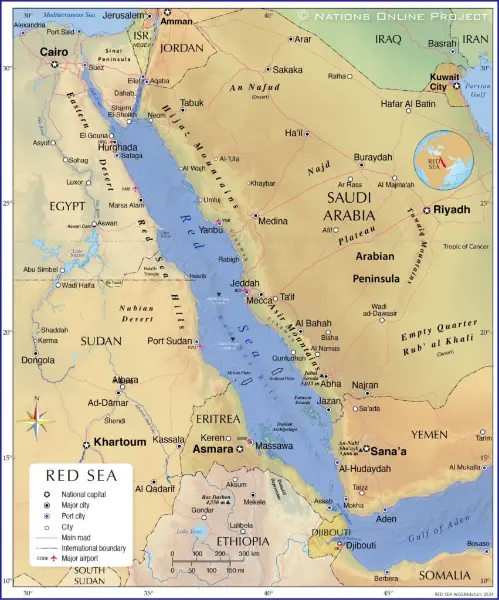 The Red Sea extends from the Suez Canal in the north to the Bab el-Mandeb Strait in the south. The Gulf of Aqaba and Gulf of Suez are its northern extensions. Here's what its geography includes:
- North: Egypt, Israel, Jordan
- West: Egypt, Sudan, Eritrea
- East: Saudi Arabia, Yemen
Egypt and the Red Sea
Ancient Egyptian Use of the Red Sea Pharaonic Expeditions: As far back as 2500 BCE, pharaohs sent expeditions across the Red Sea to the Land of Punt for exotic goods, gold, and incense.Wadi al-Jarf and Ayn Sukhna: These ports on the Red Sea unveil the existence of shipyards and harbor facilities of ancient Egypt. Many historical tours explore this legacy.
Maritime Innovation
Early ships for seafaring were innovated by Egyptians to sail the Red Sea, showing advanced knowledge of winds and navigation. Some cultural tours highlight this naval expertise.
Biblical Connection
The parting of the Red Sea is a central event in the Exodus story, through which the Prophet Moses (Musa) leads the Israelites out of Egypt. Its exact location is disputed, but it connects Egypt firmly to biblical and Islamic tradition.
Pilgrimage Routes
In the Islamic period, the Red Sea emerged as a fundamental Hajj route, particularly for Egyptian pilgrims traveling by sea from Suez or Aydhab to Jeddah. The region remains part of many spiritual experiences.
The Islamic and Ottoman Era
Ayyubids and Mamluks defended the Red Sea coast against Crusaders and Portuguese incursions.
Under the Ottomans, Egypt's Red Sea ports were strategic outposts in a larger imperial network—highlighted in multi-city adventure tours.
The Suez Canal and Modern Maritime Power
Opening of the Suez Canal (1869)
Linked the Mediterranean Sea to the Red Sea, making Egypt the hub of international maritime trade.
The canal significantly shortened the travel distance between Europe and Asia and is featured in grand Egypt itineraries.
Strategic Importance
Today, the Suez Canal is one of Egypt's most precious economic assets, generating billions of dollars in revenue annually. Its strategic value is emphasized in luxury travel packages.
Tourism and the Economy
The Red Sea coast is a major hub for diving, snorkeling, and beach tourism.
Destinations like Sharm El-Sheikh and Hurghada attract millions of visitors annually.
Coral reefs, marine biodiversity, and clear waters make it a top global destination for eco-tourism—also covered in wellness-themed tours.
Military and Political Role
Egypt maintains a strong naval presence in the Red Sea.
It plays a key role in regional alliances, counter-piracy operations, and security around the Suez Canal. These themes are often explored in regional overview trips.
Also Read about: cost to go to Egypt
Importance of Ancient Egypt Red Sea
Here’s the information about the importance of the Red Sea in Ancient Egypt organized in a clear table format:| Aspect | Importance of the Red Sea |
| Trade & Economy | |
| Exploration | - Allowed long-distance voyages, such as Queen Hatshepsut’s expedition to Punt |
| - Expanded Egypt's knowledge of distant lands and resources | |
| Maritime Innovation | - Encouraged the development of early seafaring and shipbuilding |
| - Egyptians mastered use of winds and seasonal navigation | |
| Military Strategy | - Secured Egypt’s eastern frontier against threats |
| - Provided access to and control over mineral-rich Sinai mines | |
| Religion & Culture | - Imported exotic animals, incense, and goods used in temples and rituals |
| - Strengthened the Pharaoh’s divine image through access to rare offerings | |
| Diplomacy & Influence | - Connected Egypt to the Arabian Peninsula and East Africa |
| - Enhanced Egypt's status as a regional power through diplomacy and trade |
Interesting Facts About the Red Sea
1. One of the Saltiest Seas in the World
The Red Sea has one of the highest salinity levels among seas—about 4% salt content—due to high evaporation and low freshwater inflow.2. A Living Laboratory for Marine Biodiversity
The Red Sea is home to over 1,200 species of fish, 10% of which are found nowhere else on Earth, including brightly colored reef fish and rare types of coral.3. A Natural Coral Aquarium
It contains over 200 species of hard coral, making it one of the world’s most beautiful and accessible coral reef systems—ideal for snorkeling and diving.4. A Rift in Progress
The Red Sea is a young oceanic basin and a part of the Great Rift Valley. Tectonic activity is slowly pushing Africa and the Arabian Peninsula apart at about 1 cm per year.5. Mentioned in Ancient Texts
The Red Sea is famously referenced in the Qur’an, Torah, and Bible—notably in the story of Prophet Musa (Moses) and the parting of the sea.6. Warm Waters All Year Round
The sea maintains temperatures of 26–30°C (79–86°F) throughout the year, making it ideal for marine life and tourism.Fun Facts About the Red Sea
1. It’s Not Red
The name “Red Sea” may come from seasonal algae blooms that give the water a reddish tint—or from the ancient usage of color to indicate direction (red = south).2. You Can Float Like in the Dead Sea
While not as buoyant as the Dead Sea, the Red Sea’s high salinity still makes it easier to float than in typical ocean water.3. Shipwreck Heaven
-
Shipwreck Heaven – see some on photography tours
4. It’s a Border Between Two Continents
The Red Sea separates Africa and Asia, connecting the Mediterranean Sea to the Indian Ocean via the Suez Canal—a major global shipping route.5. It’s Home to Underwater Hot Springs
Rare underwater hydrothermal vents exist in the Red Sea—extremely hot and mineral-rich, supporting unique lifeforms that thrive in extreme conditions.6. Some Marine Creatures Can “Glow”
Bioluminescent organisms, such as plankton, can be seen glowing in the Red Sea at night, especially in calm bays and lagoons. Also Read about: cheapest time to visit EgyptTours and Things to Do In Red Sea
Water Adventures- Scuba Diving & Snorkeling: The Red Sea is famous for its myriad marine species and clear waters. Some of the most popular dive sites are:
- Daedalus Reef: At nearly ninety kilometers from Marsa Alam, this isolated reef is well known for its coral formations and the historic Daedalus Reef Lighthouse.
- Brothers Islands: Situated at sixty-five kilometers east of El Quseir, these islands harbor the Brothers Islands Lighthouse and offer a plethora of marine life.
- Blue Hole (Dahab): Perhaps the most famous dive site, with a depth measured at more than 100 meters, a magnet to all freedivers and technical divers.
- Snorkeling Tour: Great for those who love to stay closer to the surface, snorkeling trips to sites such as Giftun Islands allow us to see colorful coral reefs and varied species of fish.
-
Experience many of these via Red Sea diving packages
- Hurghada: A resort town with its sandy beaches, active nightlife, windsurfing, and kitesurfing.
- PlanetWare
- Marsa Alam: Known for the calm beaches and close to prime diving points, it's a place preferred by all those looking for a peaceful retreat.
- Sahl Hasheesh: Located to the south of Hurghada, it is an opulent resort zone flanked with the finest accommodation and cleanest beaches.
-
Explore them in our resort-focused escapes
- Desert Safaris: Enjoy the grandeur of the Eastern Desert with a quad biking or 4WD tour, usually wrapping up with a traditional Bedouin dinner under the stars.
- Historical Sites:
- St. Anthony's Monastery: One of the oldest Christian monasteries situated on the Eastern Desert.
- St. Paul's Monastery: Another of those old ones gives clues about early Christian monastic life.
- Hurghada Grand Aquarium: It houses some 1,200 animals, with 24 exhibits including a shark tunnel and a rainforest area. It is truly an edifying and enjoyable experience for all generations.
-
Families love it during personalized trip packages
- Spa Treatments: Any spa can be found in all resorts where the visitor can relax and rejuvenate in peaceful surroundings.
- Yoga Retreats: These are available at some resorts and specialized centers, often with the Red Sea providing a beautiful background.
-
Experience calm in personalized itineraries
The Red Sea Measurements
- Length: 2,250 km (1,398 mi)
- Width: Ranges from 26 to 355 km (16 to 220 mi)
- Average Width: About 280 km (174 mi)
- Deepest Point: 3,040 m (9,970 ft)
- Surface Area: Approx. 438,000 sq km (169,100 sq mi)
Weather in the Red Sea
The Red Sea region has a hot desert climate, with temperatures ranging between 25°C to 40°C (77°F to 104°F) in summer and 18°C to 25°C (64°F to 77°F) in winter. Water temperatures are warm year-round, ideal for marine activities, especially those featured in scuba tours.
The Economic Aspects of the Red Sea
Certainly! Here’s a clear and organized table summarizing The Economic Aspects of the Red Sea:| Economic Aspect | Description | Key Examples / Details | Impact |
| Maritime Trade & Shipping | Strategic sea route linking Europe and Asia via the Suez Canal | Suez Canal; Ports like Jeddah, Port Sudan, Djibouti | Facilitates ~10% of global trade; major oil and goods transit |
| Fisheries & Marine Resources | Rich biodiversity supporting fishing and aquaculture industries | Tuna, sardines, shrimp; coral reefs supporting ecosystem | Provides livelihoods; potential for biotech and pharmaceuticals |
| Tourism & Coastal Development | Popular for marine tourism, diving, resorts, and cultural heritage | Resorts in Egypt (Sharm el-Sheik), Saudi coast; historical sites | Generates revenue and employment; attracts international visitors |
| Mineral & Energy Resources | Offshore oil & gas fields; salt and mineral extraction; renewable energy potential | Oil fields in Egypt and Sudan; salt mining; solar and wind energy projects | Contributes to energy supply and national revenues |
| Geopolitical & Economic Challenges | Security threats (piracy), territorial disputes, environmental degradation | Piracy near Bab el-Mandeb; maritime boundary conflicts; pollution | Increases risks and costs; threatens sustainability |
Table content enhanced by examples from:
Ecosystem and Marine Life
The Red Sea supports a diverse ecosystem with:- Over 1,200 fish species
- More than 200 coral species
- Mangroves and seagrass beds
- Dolphins, sea turtles, and even dugongs
Marine biodiversity like this is a major draw for photographic expeditions.
Salinity of the Red Sea
The Red Sea has a high salinity level, averaging around 40 parts per thousand (ppt). This is due to high evaporation rates, little rainfall, and lack of freshwater inflow. This salinity supports unique marine adaptations and contributes to the clarity of the water.Diving in the Red Sea
The Red Sea is a world-renowned diving destination. Popular diving spots include:- Ras Mohammed National Park
- Blue Hole in Dahab
- Thistlegorm Wreck
- Elphinstone Reef
- Brothers Islands