
What is White Oasis Egypt?
The White Desert is located in the Farafra Depression within the Western Desert of Egypt. It lies approximately 500 kilometers southwest of Cairo and is often accessed via the Bahariya Oasis, which serves as a gateway to the desert. The closest town is Farafra, a quiet oasis town nestled amid palm trees and hot springs.
Where is White Oasis in Egypt?
The White Desert is located in the Farafra Depression within the Western Desert of Egypt. It lies approximately 500 kilometers southwest of Cairo and is often accessed via the Bahariya Oasis, which serves as a gateway to the desert. The closest town is Farafra, a quiet oasis town nestled amid palm trees and hot springs.Should You Visit the White Desert?
Yes, the White Desert National Park of Egypt is worth your time, in case you are willing to engage in a surreal and off-the-beaten-path flavour. And here is why. Here is what to do so that you know how to make the choice: So what is so special about itWhen you Visit Egypt, you will see that there are huge areas of spectacular chalk land formations eroded by wind and sand over millions of years. One may expect the Pandora shape, the mushroom, shell, and icebergs out of the golden sand.
A photographer's dreamland, most notably during sunrise and sunset, as the light awakens the landscape; and at night, clear skies will be enjoyed with the starry sky, and even the Milky Way is visible.
Adventure as far as the outdoors is concerned: jeep safari, camel rides, sandboarding, camping under the stars, and sipping tea with Bedouin hosts around a campfire, similar to activities on the Egypt Family Adventure 8 Days.
Why is it called the White Oasis?
The name of the White Desert is so-called due to the magnificent white chalk rock formations that resemble an appearance of a snowy or icy landscape in the middle of the Egyptian desert. Now, this is why it is a good name:- Landscape Color
- Opposition to the Desert around It
Such surrounding deserts as the Black Desert (characteristic rocks covered with volcanoes) or golden dunes of the classic sand desert are the emphasis of the whiteness that is observed in this desert: the White Desert seems to be a cold and relaxing "oasis" of white in the otherwise warm-colored surroundings. You can experience both landscapes on trips like Enchanting Egypt.
- Symbolic “Oasis”
- Close to Real Oases
The oasis is adjacent to the oasis of Farafra, the smallest and most remote oases of Egypt, and it is approximately 15 miles to the east of the oasis and is considered the white desert. Certain tour companies and the tourists mash the names together or describe the whole region as a white oasis experience, also seen in options like Day Trip to Fayoum Oasis.
White Oasis Egypt Map
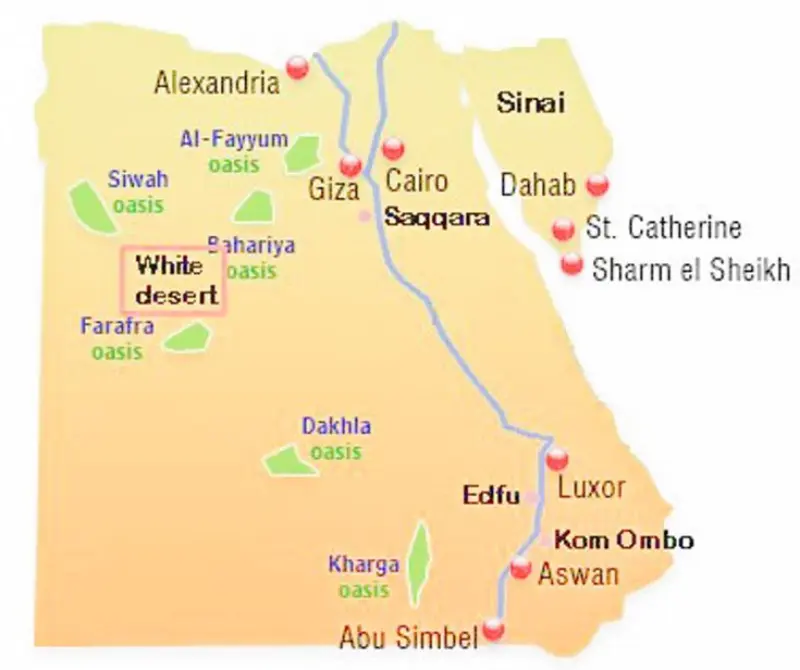
Although it is a remote area, the White Desert can be reached via several oases. The following is a plain reference to it being found:
-
Cairo to Bahariya Oasis: cars ~5 hours
-
Bahariya: White Desert: ~ 1–2 hours 4x4
-
Adjacent Oases have been Farafra (the nearest), Dakhla, and Siwa (farther west)
Hint: You are advised to choose a guided tour because the place is large, wild, and there is no good signage.
How Was the White Desert in Egypt Formed?
- Ancient Seabed Origins
About 80 million years ago, an enormous ocean had spread eastward over the land mass that is now home to the White Desert. Over millions of years, marine sediments from the sea commenced deposition:
-
A soft form of chalk
-
Primordially hard limestone
-
Fossilized shells and coral
These sedimentary layers together formed the base on which the famous white terrain of the desert has evolved — similar marine fossils are seen during the Abu Simbel Sun Festival Experience.
- Wind and Sand Erosion
After the ocean withdrew, their soft rock formations were mercilessly buffeted by:
-
Desert winds
-
Shifting sands
The chalk rock got eroded and sculpted by these forces into some of the fantastic and strange shapes seen today, ranging from mushroom-like pillars to iceberg-like ridges. The chalk and limestone, being soft, are more prone to erosion by wind.
- Tectonic Activity
- Marine Life Evidence and Fossils
-
Fossil remains of long-gone sea animals fill the desert with the following:
-
Ammonites
-
Shark teeth
-
Shells
Such is a good indication of the marine origins of the desert itself and adds to its archaeological and scientific value, much like the Explore Egypt program.
The reason why it has an appearance of whiteness is that it acts as an opener through which we can see the world and get in touch with it. -
Activities You Can Do in the White Desert
| Activity | Description |
| Desert Safari by 4×4 | Ride through the desert in a 4WD vehicle, exploring rock formations and dunes. |
| Camping Under the Stars | Spend the night in the desert with Bedouin-style tents and stargazing. |
| Photography | Capture surreal chalk formations, sunrise/sunset colors, and desert landscapes. |
| Hiking & Exploration | Walk among the formations and explore the quiet, vast desert on foot. |
| Sandboarding | Slide down soft dunes, especially in nearby areas like the Black Desert. |
| Visit Crystal Mountain | See natural rock formations filled with glittering quartz crystals. |
| Bedouin Dinner & Tea | Enjoy a traditional meal and tea prepared by local guides around a campfire. |
| Watch Sunset & Sunrise | Experience the magical transformation of the landscape in golden light. |
| Wildlife Spotting | Look for desert foxes, fennec foxes, or birds adapted to the arid environment. |
| Meditation & Relaxation | Enjoy the peace and silence of the remote desert for reflection or mindfulness. |
Overnight in the White Desert
- Under the Stars: Overnight adventure is four or five days camping in the desert. The tents or sleeping bags are placed on the soft ground by the local Bedouin guides and under the open skies. Stargazing is a memorable experience, since there is no light pollution.
- Bedouin Style Dinner: You will get a chance to taste the real desert life as you are traditionally treated to dinner usually consisting of freshly cooked Bedouin food such as grilled meat, rice, bread, and tea.
- Quietness and Tranquility: There is utmost silence in the White Desert at night as compared to the other parts of Egypt. There is the calmest silence, just a little wind or movement by lions or some animals.
- Sunrise Views: You will wake up in the morning at dawn when the desert becomes transformed again, when the first rays fill in the chalky formations, producing new forms and shadows.
Is There Animals in White Oasis?
Yes, though sparse. The harsh desert climate limits wildlife, but you may spot:- Fennec foxes (tiny desert foxes that sometimes visit campsites)
- Desert hares
- Lizards and small reptiles
- Migratory birds in certain seasons
How I Got to the White Desert
In Cairo, my journey started with a small-group tour. After the five-hour drive to Bahariya Oasis, we transferred to 4x4 vehicles and ventured into the desert. The scenery change was breathtaking: from a busy city to endless white dunes. We stopped at Crystal Mountain, checked out Mushroom Rock, and set up camp in the heart of White Desert.Other Sightseeing Near White Oasis
Bahariya
A relatively few hours away, this lush green oasis is often the starting White Desert tours.
There is the Golden Mummies Museum, Temples of Alexander the Great, and the hot springs scattered all over this area.
A wonderful place to steep in the local life and explore the ancient Egyptian-Greco-Roman history.
Black Desert
In stark contrast to the White Desert, the Black Desert consists of volcanic hills and dark rock formations, with a coating of black powder.
An ascent up the volcanic mountain of Gebel al-Ingleez will reward you with panoramas of the surrounding desert.
Crystal Mountain
It is a very small yet dazzling assembly of natural quartz crystals.
Often treated as a quick roadside stop between Bahariya and Farafra.
The crystals glisten under the sun and offer an irresistible spot for photography amongst tourists.
Farafra Oasis
A quieter, more traditional oasis town with the Badr Museum, and its art and sculpture inspired by desert life and created by a local artist, Badr Abdel Moghny.
It is also a place to find hot springs and a launchpad into the deeper desert explorations.
Ain Khadra Oasis (Green Spring)
A well-hidden Oasis among the palm trees and date groves.
It provides a beautiful natural spring and quiet place: a nice place to take a break or have desert tours.
Djara Cave
An ancient cave with cave paintings and magnificent stalactites and stalagmites.
It is situated in the Western Desert and can only be reached after a long off-road travel course, and is usually included in the desert safari trip maximum of days.
El Heiz Village
A small village of Bahariya and Farafra is broken in calm.
The place is famous for its natural hot springs and date farms.
An excellent place to visit when one is around in search of a place that exposes one to oasis life.
Agabat Valley (Wadi al-Agabat)
The spectacular valley with golden smooth dunes and white jagged cliffs.
Drama scenery and excellent photography, sandboarding, and a serene, good experience of meditation.
This is usually part of the overnight safari tours.
Magic Spring (Ain al-Serw)
A beautiful natural spring in the desert between green and palm trees.
Gives an unexpected blast of life to the lifeless terrain and a shady spot to loosen up on a hot day.
Qasr el-Farafra (Farafra Fort)
A mudbrick fortress in Farafra, which was once utilized in securing the oasis.
In ruins, it provides information about the fortifications of the oasis towns.
Interesting enough to visit the history fans and people who like to visit non-touristy spots.