
What Were Ancient Egyptian Cities Like?
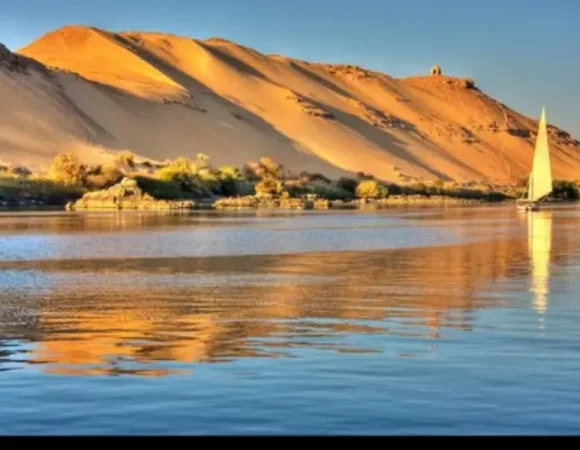
Ancient Egyptian towns were typically founded to either the Nile itself or an oasis. Their plans varied oddly depending on whether a city was an administrative capital, a religious center, or a trading hub. Most of them had temples, administrative buildings, granaries, markets, and residential areas. The architecture comprises mudbrick houses with narrow alleyways and large areas of empty courtyards. There were usually high walls protecting cities, with the temples being central to urban life. The visible stratifications of the social classes were reflected in the cityscape, as the ones living in grand villas were elite and officials, while the laborers and other artisans lived in crammed areas. Trade was a chief aspect of urban life, and the markets existed with buoyancy and activity. The cities would observe cleanliness and order and have very crude drainage systems, as well as public spaces for gatherings.Major Cities in Ancient Egypt in Order
- Thinis (This)
- Period: Early Dynastic Period
- Role: Perhaps the first capital of a unified Egypt under Narmer (c. 3100 BCE).
- Notes: Location is disputed, but many believe near Abydos.
-
Read more in this Pharaoh’s Journey.
- Abydos
- Period: Early Dynastic-New Kingdom
- Role: Religious center for the Osiris cult.
- Notes: Famous for its royal tombs and temples, including Seti I's memorial temple.
-
Explore this heritage with the Coptic Day Tour.
- Elephantine
- Period: Old Kingdom to the present
- Role: A Southern frontier city and trade center.
- Notes: Near the modern town of Aswan; controlled traffic on the Nile and trade with Nubia.
-
Visit it through the 6 Days 5 Nights Cairo, Aswan, Luxor and Abu Simbel.
- Hierakonpolis (Nekhen)
- Period: Predynastic to Early Dynastic
- Role: An important religious and political center before unification.
- Notes: Important for early kings and the cult of Horus.
-
See more in the Islamic Cairo Heritage Tour (3 Days).
- Sais
- Period: Late Period
- Role: Capital during the 26th Dynasty (Saite Period).
- Notes: Home of the goddess Nieth, the one who revived the culture of Egypt.
-
Get a taste of cultural revival in the Egypt in Style Tour.
- Itjtawy
- Period: Middle Kingdom
- Role: Capital established by Amenemhat I.
- Notes: Exact position is still uncertain and might be near Faiyum.
-
Explore the oasis nearby with the Day Trip to Fayoum Oasis.
- Avaris (Perunefer)
- Period: Second Intermediate Period
- Role: Capital of the Hyksos rulers.
- Notes: To the east of the Delta; very important for foreign trade.
-
Step into ancient trade routes through the Discover the Wonders of Ancient Egypt.
- Pi-Ramesses
- New Kingdom
- It was, as stated above, the capital of Ramesses II.
- It is located in the Nile Delta and built entirely for the display of grandeur and military might.
-
Travel back with the Grand Egyptian Museum Experience (2-Day Package).
- Deir el-Medina
- Period: New Kingdom.
- Function: Workmen's village for tomb builders in the Valley of Kings.
- Insight into daily life, as evidenced by the documents preserved and houses.
-
For a deep dive into everyday life, check the Enchanting Egypt Tour.
- Akhetaten (Amarna)
- New Kingdom, 18th Dynasty
- Capital built by Akhenaten did not last long.
- This is a unique city built solely around the worship of Aten and abandoned after his reign.
-
Understand this religious shift on the Islamic Cairo Day Tour.
- Tanis
- Third Intermediate Period
- It is the capital of the 21st and 22nd Dynasties.
- Known chiefly for its royal tombs and later as a Delta capital.
-
Explore this Delta region in the Pyramids Pathaway Trip.
- Bubastis (Per-Bastet)
- Late period
- Center of worship for the cat goddess Bastet.
- Important festival site and lively city during the 22nd Dynasty.
-
Feel the festive spirit in the Egypt Photographers Dream (12 Days).
Famous Cities in Ancient Egypt
Memphis
Originally established some 5000 years ago around 3100 BCE, Memphis at that time emerged as the first capital of an Egypt that was then, for all practical purposes, unified. A site at the mouth of the Nile Delta, it had great strategic importance for economic trade and results of administrative transactions. Here lies the fine temple of Ptah father of many creative godspowers, and this also forms the hub for the arts and craftsmanship around the world.Uncover Memphis' past with the Pyramids Day Trip.
Thebes (Waset)
Found in Western Upper Egypt, Thebes became the capital in both the Middle Kingdom and New Kingdom periods. In particular, it has the great temple complexes of Karnak and Luxor. The Valley of the Kings, near it, contained tombs of many pharaohs. But much more than that, Thebes was the epitome of power, piety, and, last but not least, royal legacy.Experience this with the One Day Itinerary – Pyramids, Sphinx & GEM.
Heliopolis
Not a political capital yet with a significant religious influence, Heliopolis (Iunu in Egyptian) was the major cult center for Ra, the sun god, who became a center of solar worship. At least as far as Egyptian theology is concerned, it has been effective in shaping and lasting ages.Abydos
The holy city of Osiris, god of the afterlife, is remarkable, for pilgrims came to this place to be buried close to the god, or to build tombs in a symbolic form. This city had the temple of Seti I and a considerable amount of important inscriptions related to funerary practices.Alexandria
Built by Alexander in 331 BC, Alexandria is one of the most commercially active cities of Greco-Egyptian origin. It is home to the well-known Lighthouse of Pharos and the Library of Alexandria, and draws not only scholars but merchants from all corners of the ancient world. Also Read about: what is the bent pyramidBiggest Cities in Ancient Egypt
While estimates regarding populations tend to be speculative, archaeological evidence and historical records suggest the following largest cities:- Memphis – at its peak, the population may have been between 30,000 and 40,000
- Thebes, during the New Kingdom, may have had a population upwards of 75,000
- Alexandria, the largest city during the later times, with estimates ranging from 300,000 to 530,000
- Heliopolis, not so large but heavily populated, owing to its temple complex and priestly class.
Main Cities in Ancient Egypt
These cities functioned as the main centers of power, religion, and trade:- Thinis – Early dynastic capital.
- Memphis – Longtime political capital and religious center.
- Thebes – Religious capital and site of royal tombs.
- Amarna – Capital during Akhenaten’s reign.
- Tanis – Important during the Third Intermediate Period.
- Hermopolis – Intellectual center, home to scribes and philosophers.
- Elephantine – Strategic city near Nubia and key trading post.
Ancient Egyptian Cities Along the Nile
- Elephantine (modern-day Aswan)
- Location: First Cataract of the Nile
- Role: Gateway to Nubia; trade and military outpost
- Highlights: Nilometer, temple of Khnum
-
Experience this with a Cairo, Siwa & Alexandria Adventure.
- Philae
- Location: Near Aswan, on an island in the Nile
- Role: Religious site for the goddess Isis
- Highlights: Beautiful temples now relocated due to the Aswan Dam
-
Learn more on a 4 Days, 3 Nights Egypt Tour.
- Edfu
- Location: South of Luxor
- Role: Religious center of the god Horus
- Highlights: Edfu Temple is located here, one of the best-preserved temples in Egypt
-
This is a must-see in the Explore Egypt Trip.
- Esna
- Location: South of Luxor
- Role: Religious and agricultural town
- Highlights: Temple of Khnum
-
Featured on the Luxury Nile & Desert Retreat (10 Days).
- Thebes (Waset)
- Location: Modern Luxor
- Role: Political and religious capital during the Middle and New Kingdom
- Highlights: The temples of Karnak, Luxor, and the Valley of Kings
-
Explore this legacy in the Discover Your Passions Tour.
- Armant (Hermonthis)
- Location: Near Luxor
- Role: Center of cult activities for Montu, the war god
-
Uncover ancient rituals in the Egypt Wellness Journey (9 Days).
- Akhetaten (Amarna)
- Location: Modern Tell el-Amarna
- Role: The capital of Akhenaten's monotheistic revolution
- Highlights: An unusual layout and architecture
-
Visit on the Romantic Escape (10-Day Honeymoon).
- Abydos
- Location: North of Luxor
- Role: A major religious center of Osiris
- Highlights: Temple of Seti I; ancient royal tombs
-
Featured in the Abu Simbel Sun Festival (5 Days).
- Dendera
- Location: Near Qena
- Role: Cult center of Hathor
- Highlights: Temple complex with zodiac ceiling
-
Experience this during Ramadan in Egypt (7 Days).
Ancient Egyptian Cities Map
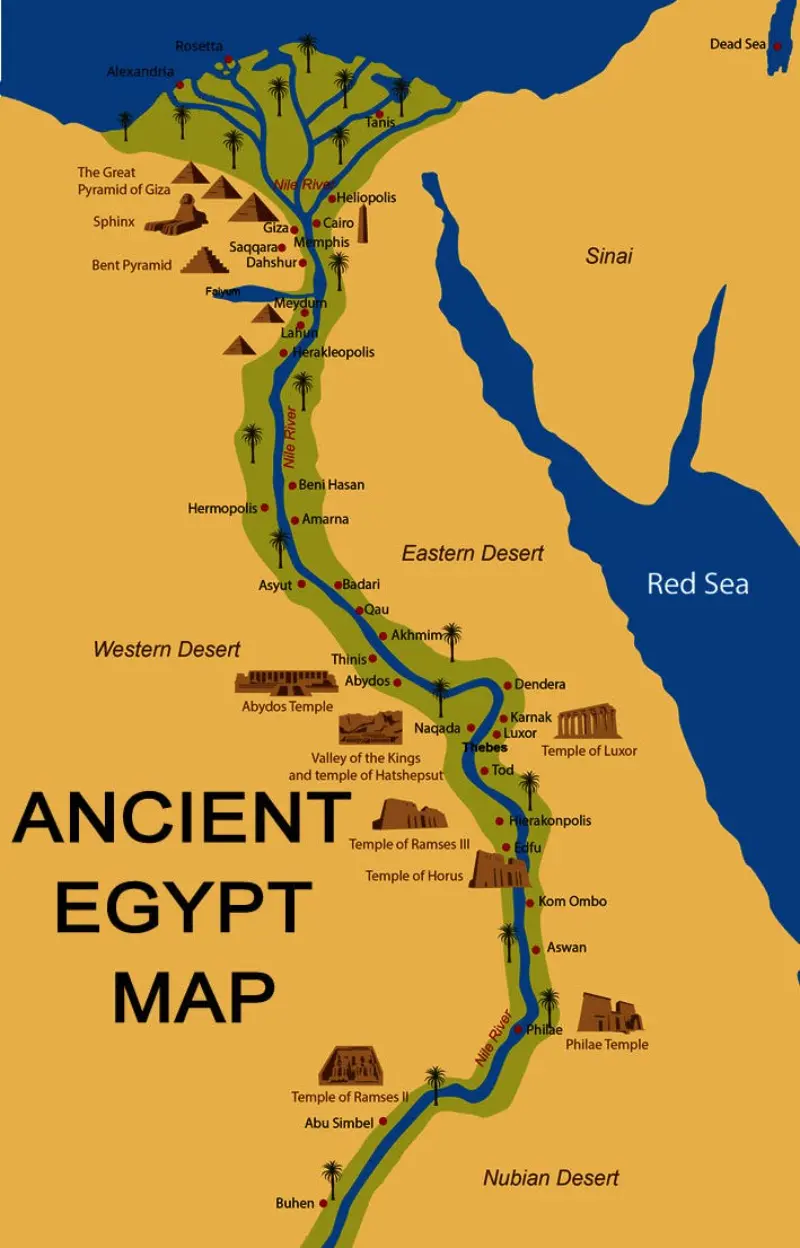 Visualizing the geography of ancient Egypt helps understand the strategic placement of its cities. Most were located along the Nile for easy access to water and trade. A map of ancient Egypt would typically show:
- Upper Egypt in the south: Thebes, Edfu, Aswan.
- Lower Egypt in the north: Memphis, Heliopolis, Alexandria, Tanis.
- Middle Egypt: Hermopolis, Amarna, Abydos.
Facts About Ancient Egyptian Cities
- Most Cities were Anchored by the Nile
- Cities Were Divided by Functions
Cities were divided into zones: portions for habitation, trade, temples, and different state institutions.
The adjacent or commonly visible part of the city was where the pharaoh's palace was built alongside an equal-sized religious temple.
For more insights, try the 6 Days, 5 Nights Egyptian Tour.
- The Capital Has Been Moving
Dive deeper with Nile Legacy: Luxor & Cairo Adventure.
- Temples Marked Cities
Also part of the Red Sea Diving Adventure (5 Days).
- Urban Planning Was Advanced
This early planning is featured in the Epic Egypt (14 Days).
- They Were Independent Townships of Workers:
- Cities Were Places of Religion and Politics
- Trade and Places of Exchange Were Fundamental
See this vibrancy in Customize Your Trip.
- Rare City Walls
- City Names Denoted Their Usefulness
Examples: Per-Bastet (House of Bastet), Iunu (Heliopolis).
Also Read about: Day Trip Aswan to Abu Simbel
Best Times to Visit Egypt
- Best Overall Time: October to April
- Why: Nice temps for cities like Cairo, Luxor, and Aswan.
- Daytime temps: Approx. 20°C to 28°C (68°F to 82°F), ideal for sightseeing.
- Activities: Excellent for temple and pyramid visits, and Nile cruise activities.
- Bonus: High season, meaning larger crowds and higher prices.
- Best Atmosphere: November to February
- Why: Cool conditions make walking around ancient sites like the Valley of Kings or Giza Pyramid much more enjoyable.
- Note: It can get cold in the open desert in the mornings and evenings, so come prepared with some layers.
- Tip: If you want to avoid congested tourist traffic, plan for early November or late January.
- Best for Budget Tourists: May and September
- Why: These are the shoulder seasons, with fewer tourists and better deals on hotel accommodations.
- Weather: Hot weather concludes, particularly in Upper Egypt (Luxor, Aswan), but still manageable.
- The downside: You get shorter lines and less expensive rates, while the heat is rising.
- Best for the Red Sea and Beaches: March to May or September to November.
- Where: Hurghada, Sharm El-Sheikh, Marsa Alam.
- Reason: Warm waters and sunny skies, not too hot during summer.
- Activities: This is the best time for snorkeling, diving, and lying by the water.
- Avoid Those Months: June to August (Unless You're Right on the Shore)
- Why: This is the zenith of Egyptian summer. Temperatures mostly rise above 40°C (104°F), especially in places like Luxor and Aswan.
- Exceptions: By the sea, prices go down this time of the year, and Alexandria or Red Sea resorts are nicer and pleasant!
- Bonus: Fewer tourists, lower pricing if you can withstand the blistering sun.