
What is Khan El-Khalili and Its History
Khan El-Khalili is not just another tourist stop in Cairo - this maze-like market is the real deal. Dating back centuries, it's where locals and travelers alike come to haggle, socialize, and witness authentic Egyptian culture. The narrow alleys are packed with shops selling everything imaginable, while the scents of spices, coffee, and shisha swirl around you. It's noisy, chaotic, and magical.
Every time I visit, I discover something new - a hidden workshop, a family-run cafe, or an artisan continuing traditions from another era. This isn't some sanitized tourist attraction; it's Cairo's living, breathing commercial heart. Whenever a friend of mine says I’m visiting Egypt, I cannot stop myself from saying, Don’t forget to pass by Khan El-Khalili.
How Was the Khan El-Khalili Bazaar Founded?
The market's story starts way back in 1382, when a guy named Emir Djaharks el-Khalili (working for Sultan Barquq) turned an old caravanserai - a roadside inn where travelers would rest—into a commercial hub, and man, did it take off! Initially, it was just meant to be a place where merchants could safely store and sell their goods after long journeys across the desert. The sultan set it up as a waqf (a kind of Islamic charitable trust), which helped it become permanently established in Cairo's landscape. What amazes me is how the place evolved organically over the centuries. Craftsmen set up workshops. Traders from Syria, North Africa, and beyond brought exotic goods. Coffee houses opened where people exchanged news and stories. Before anyone realized it, Khan El-Khalili had become more than a market - it was the place where Cairo's commercial and social life converged, offering visitors a chance to take home genuine pieces of Egyptian culture.How Old Is Khan El-Khalili?
Can you believe this place is over 640 years old? Built in 1382 during the Mamluk period, Khan El-Khalili has witnessed pretty much the entire modern history of Egypt. That's older than the Americas as we know them!The thing that gets me every time I walk through the bazaar is thinking about all the history these stones have seen. The Mamluks, the Ottoman takeover, Napoleon's invasion, British colonialism, the 1952 revolution - through it all, merchants kept selling, craftsmen kept creating, and shoppers kept haggling.
You'll notice the architecture tells this story too - some buildings have that classic Mamluk style, others show Ottoman influences, and some parts have been rebuilt or modernized over the years. But somehow, it all works together.
Today, Khan El-Khalili isn't a museum piece - it's still a working market where Egyptians shop alongside tourists hunting for the best things to buy in this legendary bazaar. The same paths where medieval traders once hauled their exotic goods now guide travelers looking for the perfect souvenir from Cairo. Are you ready to visit Egypt and get some of those souvenirs?
Khan El-Khalili Location
Khan El-Khalili sits smack in the middle of what everyone calls "Islamic Cairo," though to be honest, that doesn't help much when you're jet-lagged and trying to explain to your taxi driver where to go! It's somewhere near Al-Azhar Mosque (the huge one) and Al-Hussein Mosque, if that helps. My phone totally died the first time I tried finding it, and I ended up following a bunch of tourists who looked like they knew where they were going. The thing about Khan El-Khalili's location is it's literally in Cairo's old town. Not the fake "historic district" kind you get in some cities - it's the ACTUAL medieval part where people have been buying and selling stuff for like 700 years! You could even combine your visit with an Islamic Cairo tour.Why Is It Located in Islamic Cairo?
Islamic Cairo isn't just a fancy name tour guides made up. My Egyptian friend Mahmoud explained that this whole area basically IS the original Cairo, built after the Arabs took over in 641. Everything else came later. This neighborhood has some insane history packed into it. You've got Al-Azhar Mosque (from 970!!), which has been teaching students since before most European universities were even idea. There are madrasas (old-school schools, lol) everywhere, plus houses with these crazy wooden balconies that look like they'd collapse if you sneezed near them. (They won’t trust me.) The cool part? Khan El-Khalili isn't just randomly plopped here. Back in the day, markets were basically where EVERYTHING happened - shopping, gossip, politics, you name it. Nestled in Islamic Cairo, Khan El-Khalili Bazaarserves as a gateway to Egypt's past, offering visitors not only a shopping experience but also a glimpse into its storied history. I bought this copper teapot from a guy whose great-grandpa supposedly made teapots for some Ottoman bigwig, then walked like 20 feet to an ancient mosque. Where else can you do THAT?? Also Read about: Emmanuel Macron in Egypt: A Visit Blending Politics and CultureKhan El-Khalili Bazaar Map
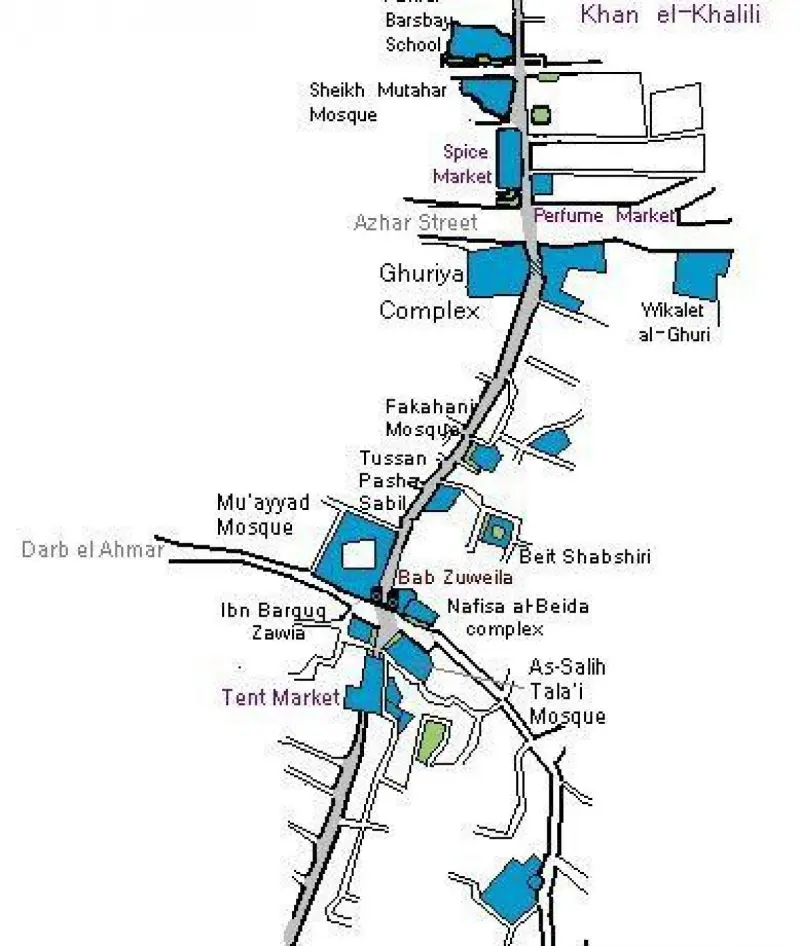 Honestly, calling Khan El-Khalili "confusing" is the understatement of the century! The first time I went, I swore the place was designed by someone who HATED straight lines. The main entrance is off El-Muizz Street, but after that... good luck!
There's a sort of pattern if you look hard enough. The north section has most of the gold and silver shops (bring your wallet!). Somewhere in the middle, you'll find the spice market—you'll smell it before you see it. The touristy stuff is kinda everywhere, but especially near the entrances. And scattered throughout are these little coffee shops where old guys play backgammon like they've been sitting in the same spot since 1950. It’s the kind of authentic local experience you won’t forget.
Do yourself a favor and download Maps.me or something before you go - Google Maps freaks out in those tiny alleys. Or just accept getting lost as part of the fun!
The Architecture of the Khan El-Khalili Bazaar
The buildings in Khan El-Khalili are a crash course in Egyptian history. You've got these amazing Mamluk structures (those were the military dudes who ruled Egypt before the Ottomans) with their striped stone patterns. I spent like 20 minutes staring at one doorway with the craziest geometric designs - that's called "muqarnas," according to some random architecture student I met. Then there's the Ottoman stuff, which came later - more rounded arches and those awesome mashrabiya windows with the wooden lattice screens. My Airbnb host said those were so women could look outside without being seen.The whole place is connected by these super narrow alleys that sometimes get so tight you have to turn sideways to let people pass! The bazaar's architecture adds to its charm, creating the perfect backdrop for your shopping adventure. Though FYI, you'll be too busy dodging persistent shop owners to appreciate most of it! I nearly knocked over an entire display of brass lamps because I was looking up at a 500-year-old archway instead of where I was going.
So now you are in the middle of everything; let me tell you what not to miss doing there besides shopping!
Things to Do in Khan El-Khalili
Shopping's just the beginning at Khan El-Khalili! My favorite day here wasn't even about buying stuff. I wandered into this ancient courtyard that wasn't in ANY guidebook. I just spotted a doorway behind a spice shop and got curious. Hit up El-Fishawi Café (locals call it "Café of Mirrors"). It's been around since 1773!!! I spent 2 hours nursing one mint tea while watching this wild mix of tourists and Cairo locals. The famous writer Naguib Mahfouz used to hang out here. Don't miss Al-Hussein Mosque. I got talking to this old guy selling prayer beads nearby who showed me photos of his grandkids for like 20 minutes. At sunset, climb to any rooftop café. The golden light hitting those ancient minarets while the market chaos continues below? Pure magic - even with my crappy phone camera! Also Read about: who built abu simbelKhan El-Khalili Bazaar What to Buy There
After three trips to Khan El-Khalili, I've bought way too much stuff (my suitcase zippers have the battle scars to prove it!). Here's my honest take on what to buy at Khan El-Khalili bazaar - from someone who's made both awesome purchases and total tourist mistakes:1. Spices
The spice displays are INSANE – mountains of colorful powders that'll make your Instagram followers drool. I grabbed some za'atar that completely transformed my boring weeknight chicken, plus cumin that smells 10 times better than the stale stuff at home.Related: Explore Egypt 2. Essential Oils and Perfumes
-
These tiny bottles of scented oils are everywhere in the bazaar. The shop guys will dab some on your wrist whether you want it or not!
Discover more on the Egypt Wellness Journey – 9 Days
3. Handmade Jewelry
I'm still wearing the silver bracelet with turquoise stones I haggled way too long for. The goldsmith area is next level - these guys aren't messing around with tourist trinkets. My friend spent way too much on a gold cartouche with her name in hieroglyphics, but honestly? Worth every penny. My hard-learned tip: Haggle, but don't be a jerk about it. I started at 40% of the asking price for my bracelet, and we met somewhere in the middle. The shopkeeper threw in a pair of small earrings for free, probably just to get rid of me after our 20-minute negotiation marathon!I'm still wearing the silver bracelet with turquoise stones I haggled way too long for.If you're into handcrafted items, check out the Pharaohs’ Journey.
4. Papyrus Art
These painted papyrus sheets are literally in every shop. Some are gorgeous; others look like they were painted during a bumpy bus ride. I bought one with the Egyptian calendar that now hangs in my office and starts conversations. These painted papyrus sheets are literally in every shop.Pair your art hunt with the Egypt Photographer’s Dream – 12 Days.
5. Copperware and Brassware
The lanterns, OMG, the lanterns! They cast the coolest patterns on your walls when lit. I bought this tiny brass teapot that's impractical but looks amazing on my bookshelf. The metalwork here ranges from cheap and flimsy to heirloom-quality stuff. The lanterns, OMG, the lanterns! They cast the coolest patterns on your walls when lit.Want more inspiration? Try the Luxury Nile & Desert Retreat – 10 Days.
6. Textiles and Scarves
I found the SOFTEST cotton scarf with this intricate blue embroidery that I've worn to death. The textile shops are sensory overload - piles of fabrics in every color imaginable. My mom still uses the table runner I got her, even though one corner is already fraying. I found the SOFTEST cotton scarf with this intricate blue embroidery that I've worn to death.Experience local craftsmanship on the Enchanting Egypt tour.
7. Alabaster Statues
These white stone carvings catch the light beautifully. I got a small Bastet cat statue that everyone thinks is way more expensive than it was. The bigger pieces are gorgeous but weigh a TON. These white stone carvings catch the light beautifully.This vibe matches the Discover the Wonders of Ancient Egypt itinerary perfectly.
8. Sheesha Pipes (Hookahs)
These ornate water pipes are everywhere in Khan El-Khalili. My roommate wanted one for our apartment and spent ages picking out the perfect design with blue glass and intricate metalwork. We've used it exactly twice. These ornate water pipes are everywhere in Khan El-Khalili.Pair your cultural curiosity with the Ramadan in Egypt – 7 Days.
9. Traditional Galabeyas
I bought a men's galabeya (those long loose robes), thinking I'd wear it as a beach cover-up. It's now my favorite thing to lounge around in on Sundays! The embroidery around the neck is so detailed, you can tell it's handmade. I bought a men’s galabeya (those long loose robes), thinking I’d wear it as a beach cover-up.Find more authentic experiences on the 6 Days 5 Nights Cairo, Aswan, Luxor & Abu Simbel.
10. Egyptian Cotton Products
Egyptian cotton is famous worldwide for a reason! I splurged on sheets that still feel amazing three years later. The towels make great gifts because they pack flat, and everyone appreciates quality bathroom stuff. Egyptian cotton is famous worldwide for a reason!Luxury lovers can check out Egypt in Style.
11. Antique Replicas
Let’s talk replicas, because Khan El-Khalili has some seriously convincing ones! I couldn’t resist grabbing a tiny obelisk for my desk; it looks so legit that visitors keep asking if it’s genuinely ancient. (Spoiler: It’s not.) But hey, it still sparks fun conversations! I did, however, steer clear of those massive sphinx statues. Sure, they’re impressive, but unless you’ve got a palace to decorate, they’re probably not practical. Let’s talk replicas, because Khan El-Khalili has some seriously convincing ones!Match that passion with the Abu Simbel Sun Festival – 5 Days. My hard-learned tip: Size matters, more than you’d expect! What vendors call “medium” often ends up being way larger once you get it home. And as for claims of “authentic ancient stone”? Take that with a grain of salt. These replicas are meant to be fun, decorative pieces, not museum artifacts. So embrace the kitsch and enjoy the vibe—they’re perfect for adding a touch of Egyptian flair to your space!"
12. Leather Goods
Leather in Khan El-Khalili ranges from super basic to amazingly crafted. My camel leather bag has developed this gorgeous patina over time. Just don't expect designer quality at those prices. Leather in Khan El-Khalili ranges from super basic to amazingly crafted.If you're into unique materials, don’t miss the Desert Oasis Explorer – 4 Days.
13. Herbal Remedies
These mysterious packets and bottles claim to cure everything from headaches to heartbreak!Spiritual explorers may enjoy the Islamic Cairo Heritage Tour – 3 Days. Regardless of how true their medical efficacy is, these traditional remedies are highly embedded in the Egyptian culture. I grabbed some hibiscus tea (karkade) that actually does taste amazing and supposedly lowers blood pressure. My hard-learned tip: Ask exactly what you're buying and how to use it. My "digestive blend" came with zero instructions, and Google was no help with those unmarked herbs! Also, check your country's import restrictions before buying.
14. Oriental Rugs
Talk about investment pieces! My parents bought a gorgeous hand-knotted rug that's the centerpiece of their living room now. The colors are incredibly vibrant, and the wool feels amazing underfoot. My hard-learned tip: Prices vary WILDLY based on materials, knot count, and whether it's handmade. If you're serious about buying one, educate yourself first or bring someone knowledgeable.15. Nargile Charcoal and Tobacco
The flavored tobacco (mu'assel) comes in crazy varieties. My Egyptian friend swears the apple-mint mix from Khan El-Khalili is better than anything he can find elsewhere. The special quick-lighting charcoal discs are super convenient, too. My hard-learned tip: Check your customs allowance before buying! Nothing worse than having it confiscated at the airport. The vacuum-sealed packages travel better and keep the flavors fresh longer. Talk about investment pieces!For an immersive journey, try the Epic Egypt – 14 Day Tour.