
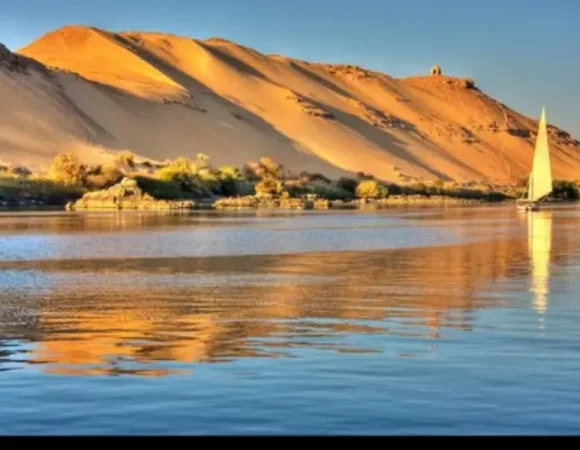
Egypt is a desert, so why is the Nile River important to Ancient Egypt? In one word: It enabled civilization. Its flooding brought nutrients to the soil, its flow allowed for transportation, and its cycle defined the way Egyptians farmed, traded, and even thought about the afterlife. This is how one river created an empire.
The Nile's Flood and Its Fertile Black Soil
The annual flooding of the Nile River which occurred from June to September brought silt deposits that made the soil very fertile. This is why the Ancient Egyptians named their land Kemet (the Black Land) and the deserts Deshret (the Red Land).
The flood wasn't just useful, it was predictable — and predictability let Egyptians plan around it:
Akhet – the flooding season
Peret – the growing season, once the water receded
Shemu – the harvest season
The three-part calendar formed the basis of Egyptian agriculture, and this is largely due to the importance of the Nile river to the sustenance of ancient Egypt in this arid environment.
Why the Nile River Was Important to Ancient Egyptian Farming
Fertile soil alone doesn't feed a civilization — it needs the right crops and the right systems. Along the Nile, farmers grew:
Wheat and barley for bread and beer
Flax for linen clothing
Vegetables, fruit, and papyrus reeds
These harvests produced more food than farming families needed, and that surplus mattered enormously. It freed up labor for people who weren't farming at all — builders, priests, scribes, and officials — which is part of how Egypt could staff temples, run a government, and build monuments on the scale it did.
The Nile as Ancient Egypt's Highway
Overland travel through desert was slow and dangerous, so the Nile carried most of Egypt's traffic instead. It also had a quirk that made two-way travel easy: the river flows north, but the prevailing wind blows south. Boats could sail south against the current using that wind, then drift north with the flow — no complicated navigation required.
That system moved more than people. It moved grain, timber, and the enormous stone blocks used to build temples and pyramids. Travelers exploring this today can retrace some of that route on a Luxury Nile & Desert Retreat – 10 Days, which follows the river past many of the sites it made possible.
Trade and Political Unification
The Nile didn't just move Egyptians around Egypt — it connected them to the wider region. Trade along the river and its delta brought in gold and ivory from Nubia to the south, along with timber and luxury goods from the Mediterranean.
Equally important, the north-south flow of the river made it easier to unify Upper and Lower Egypt as a kingdom, ruled by a single Pharaoh. The armies and officials of the state could travel the length and breadth of the country much more quickly by water than by foot.
Religious Beliefs Tied to the Nile
Egyptians didn't see the flood as a coincidence of geography — they saw it as a gift from the god Hapi. The river's rhythms also shaped ideas about life, death, and rebirth, echoed in myths about Osiris and the sun's daily cycle.
This belief system even dictated their place of residence. The temples and palaces in the ancient capital city called Thebes or Luxor were built on the eastern bank of the river with the western bank containing the Valley of the Kings where the tombs of their kings were. The characterization given by UNESCO in their list of World Heritage sites entitled "Ancient Thebes with its Necropolis" is still reflective of this orientation to this day. The difference can be observed firsthand when visiting "Epic Egypt: A 14-Day Once in a Lifetime Tour."
Building Materials from the River
The Nile supplied more than food and transport. Its mud was dried into mudbricks for homes, and papyrus reeds growing along its banks were turned into paper, rope, sandals, and small boats — everyday materials that came directly from the riverbank.
Conclusion
From fertile floodplains to funeral geography, why the Nile River was important to ancient Egypt comes down to one fact: it touched almost every part of daily and spiritual life. Want to see the river that built a civilization? Check out the Luxury Nile & Desert Retreat – 10 Days and follow its banks yourself.
Frequently Asked Questions
What would ancient Egypt have been without the Nile?
Without it, there'd have been no reliable farmland, no easy trade or transport, and likely no unified kingdom — just desert.
What did ancient Egyptians call the Nile?
They didn't use the name "Nile." They referred to it simply as Ar or Iteru, meaning "the river" or "the great river."
Why did ancient Egyptians build tombs on the Nile's west bank?
The west, where the sun sets, was linked to death and the afterlife, while the east bank held the living city.
How did the Nile help unify Egypt?
Its current made travel between Upper and Lower Egypt fast enough for pharaohs to govern, tax, and defend the whole kingdom from one center.